E-commerce
Custom ecommerce softwaredevelopment and AI services.
Building a new storefront, or hitting the limits of the platform you are on?
Corpvance builds custom storefronts, headless commerce architecture, subscription and marketplace platforms, and AI for search, recommendations, and product data. We integrate with your ERP, warehouse, payment, and marketing systems so catalog, stock, and customer data stays consistent across channels.
A small senior team. You work directly with the engineers building your product.
- 01
- Headless commerce
- 02
- Checkout and payments
- 03
- Search and recommendations
- 04
- ERP and warehouse integrations
- 05
- Cloud migration
Market Context
Most ecommerce teams are limited by their platform, not their traffic
Catalog, customer, and order data already exist. The constraint is usually what the underlying platform will let you change and how quickly.
- Revenue use cases
- Marketing and sales AI use cases most often report revenue increases
- Conversion math
- Small lifts in recommendation and search relevance compound across paid traffic
- Support load
- Order-status and returns FAQs are prime candidates for grounded assistants
McKinsey State of AI
Industry practice
Industry practice
These are engineering problems. Checkout flows that cannot be changed, catalog data duplicated across channels, and personalization that ignores stock and margin. All of them are fixable in software.
Who we build ecommerce software for
Requirements change depending on who owns the workflow. These are the organizations Corpvance works with, and what they usually need built.
Direct-to-consumer brands
Teams where site performance, merchandising, and repeat purchase rate decide the business, and platform limits are becoming the ceiling.
Custom storefronts · Personalization · Analytics
- Custom storefronts
- Personalization
- Analytics
Marketplaces and multi-vendor platforms
Operators coordinating many sellers, where onboarding, payouts, and trust are harder than the storefront itself.
Vendor portals · Payout automation · Catalog tooling
- Vendor portals
- Payout automation
- Catalog tooling
Subscription commerce
Businesses where billing logic, churn, and lifecycle messaging matter more than the initial sale.
Billing systems · Churn models · Customer portals
- Billing systems
- Churn models
- Customer portals
B2B ecommerce
Wholesalers and manufacturers selling to trade customers with contract pricing and approval rules that consumer platforms do not support.
Trade portals · Contract pricing · Order automation
- Trade portals
- Contract pricing
- Order automation
Growth and merchandising teams
Groups running experiments and campaigns against a platform that makes every change a development ticket.
Experimentation · Merchandising tools · Reporting
- Experimentation
- Merchandising tools
- Reporting
Not sure which of these fits your organization? A short scoping call is usually enough to tell whether the work is a new build, an integration, or a modernization.
What Corpvance builds for ecommerce
We can build a new commerce platform from the ground up, extend the systems you already run, or replace the manual work sitting between them.
Storefront and operational products built around how you actually sell rather than what a platform allows.
- Custom storefronts
- Headless commerce architecture
- Checkout and payment flows
- Subscription and recurring billing
- Marketplace and multi-vendor platforms
- Customer accounts and portals
- Mobile commerce apps
- Internal admin platforms
AI applied to discovery, merchandising, and the customer decisions that currently rely on intuition.
- Product search and ranking
- Recommendations and cross-sell
- Personalization engines
- Product data enrichment
- Churn and lifetime value models
- Pricing and promotion support
- Customer service assistants
- AI features inside existing products
Connections between your storefront, back office, fulfilment, and marketing stack.
- ERP integrations
- Warehouse and 3PL systems
- Payment and fraud providers
- Marketplace and channel feeds
- Marketing and customer data platforms
- Shipping and fulfilment APIs
- Data warehouses and ETL
- Reporting pipelines
Moving off a platform you have outgrown without losing traffic, rankings, or trading days.
- Headless replatforming
- Interface and UX redesign
- Cloud migration
- Performance and Core Web Vitals
- Mobile commerce improvements
- Catalog and data migration
- Incremental platform replacement
- Modern application architecture
How an ecommerce project runs
The hard parts are integration and migrating without losing traffic, so we settle those before the build scales.
- 01
Scope
We map the workflow, the systems it touches, and who needs access to what. You get a written scope and an architecture direction.
- 02
Integration check
We confirm what your ERP, warehouse, payment, and marketing systems actually expose before feature work starts.
- 03
Design
Interface and data model decisions, reviewed with the merchandising, operations, and growth teams who will use them daily.
- 04
Build
Short delivery cycles with a working environment you can log into and test at any point.
- 05
Launch and support
Security review, testing, and deployment, then continued development or a full handover to your team.
On replatforming projects we plan URL structure, redirects, and structured data before launch, because search visibility is the easiest thing to lose in a migration and the hardest to win back.
Build something new, or modernize what you already run
Ecommerce engagements start in one of two places, and Corpvance delivers both. Many projects turn out to be a mix.
Build from scratch
For a new channel, a new commercial model, or a storefront your current platform cannot support. We handle product design through to production.
- Custom and headless storefronts
- Marketplace platforms
- Subscription commerce systems
- B2B trade portals
- Greenfield architecture
- Launch and scaling support
Modernize and automate
For a store that trades well but is constrained by its platform. We improve it in stages so revenue continues while the work happens.
- Headless replatforming
- Performance and Core Web Vitals
- ERP and warehouse integrations
- Checkout and conversion improvements
- Adding AI to existing products
- Catalog and data migration
Most engagements combine both: a new storefront experience on one side, and integration with the operational systems behind it on the other.
StoneCanyon
StoneCanyon
The Business Problem
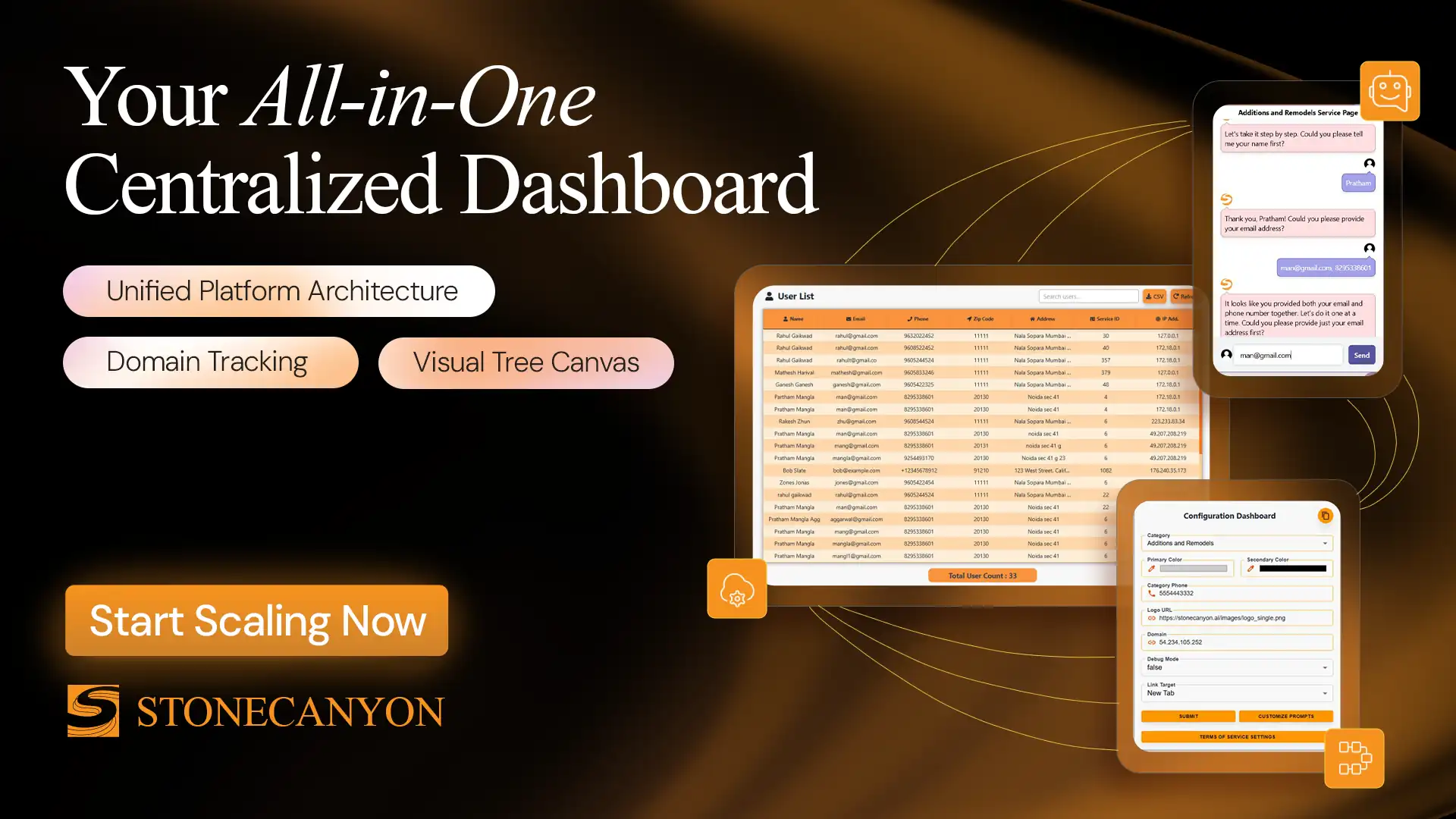
Customer-facing assistants had been deployed across different domains with no shared infrastructure, leaving no visibility into performance, lead quality, or who controlled which deployment.
What We Built
Corpvance built a single control platform where teams create, configure, deploy, and analyze every assistant from one place, with production conversations visible throughout.
What Shipped
- Unified multi-deployment control center
- Visual workflow and logic builder
- Lead capture and qualification
- Analytics and reporting dashboards
- Embeddable widget delivery
- Role-based access management
Outcome
Deployments run on shared infrastructure with consistent reporting rather than disconnected one-off integrations.
Frequently asked questions
Practical answers about scoping, compliance, integration, and how we measure success.
01Can Corpvance build an ecommerce platform from scratch?
Yes, from design through deployment, including the parts teams tend to underestimate: role-based access, performance under campaign traffic and peak trading, and the operational tooling needed to run the product once it is live.
02Can you modernize our existing ecommerce software?
Yes, usually in stages, because a store cannot stop selling while a platform is replaced.
03Can you integrate with our ERP, warehouse, and payment providers?
Yes. We build integrations through ERP APIs, warehouse and 3PL systems, payment and fraud providers, marketplace feeds, shipping APIs, and customer data platforms.
04Can you add AI to an existing ecommerce product?
Yes. Common additions are product search and ranking, recommendations, personalization, product data enrichment, churn modelling, and customer service assistants.
05Will replatforming damage our search rankings?
It can, which is why migration planning starts before the build rather than at launch. URL structure, redirect mapping, structured data, and page performance are treated as build requirements. Rankings usually move around for a period after any migration, and planning the technical foundations properly is what determines whether they recover.
06Should we go headless?
Only if the constraint you are hitting is genuinely the front end. Headless gives you full control over the storefront experience and performance, at the cost of owning more infrastructure. If your real bottleneck is catalog data, fulfilment, or back-office integration, headless will not fix it and we will say so during scoping.
Capabilities that make industry software production-ready.
Successful software implementation needs data pipelines, application interfaces, and cloud operations around the product.
Artificial Intelligence
Production AI systems with retrieval, agents, evaluation, and human review loops.
Explore Artificial Intelligence→Data & Analytics
Pipelines, warehouses, and validated datasets that make industry AI reliable.
Explore Data & Analytics→Software Engineering
Portals, APIs, and operational interfaces that put AI into daily workflows.
Explore Software Engineering→Explore other industries
Corpvance applies custom technology where workflows are repetitive, data is available, and outcomes can be measured.